
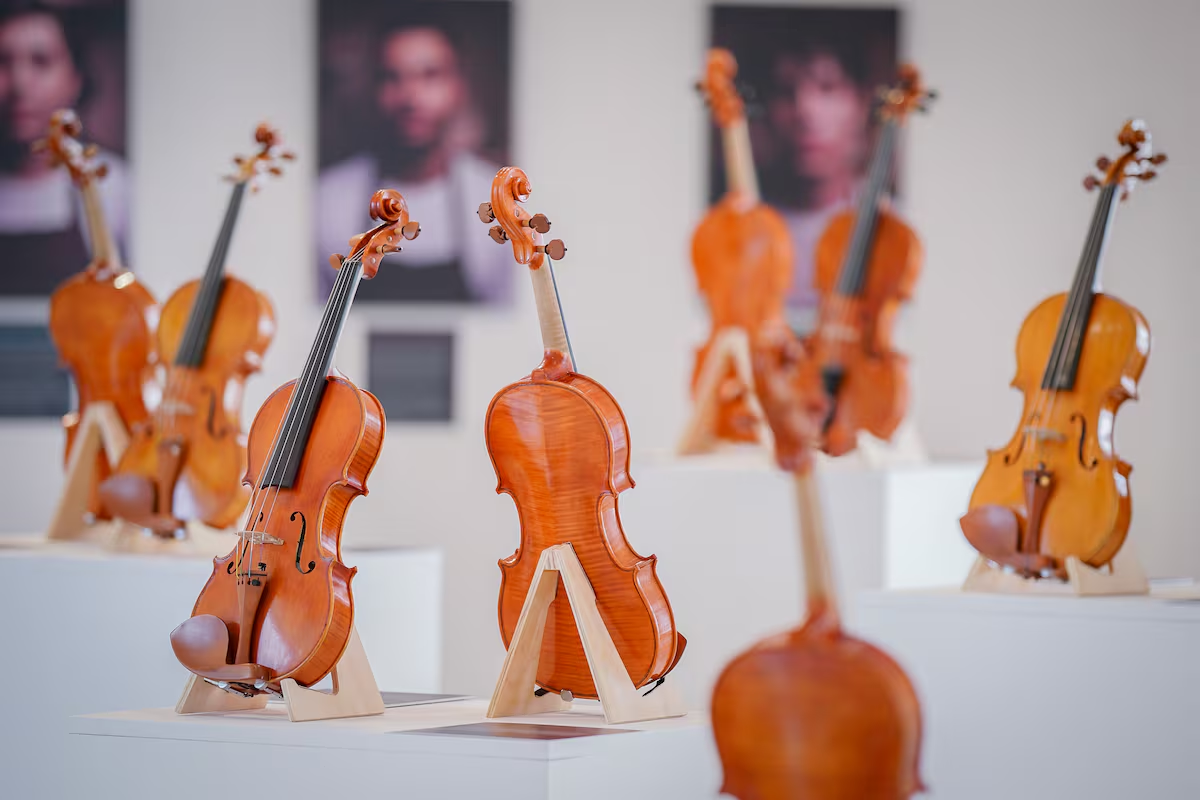

Ángel Antonio is 36 years old and obsessed with one question: who will make violins in the future? In an industrialized world where sounds seem uniform, he wonders who will carve wood in a way that allows music to transcend. He asks this without taking his eyes off a violin as he finishes polishing it, after a class with a teacher from the ancient International School of Violin Making in Cremona, which is part of the Antonio Stradivari Institute of Higher Education.
He is a violinist and a student of the visual arts. Music and sculpture are his passions. For years, he searched for a way to combine these two passions and couldn’t find a place. He researched, waited, and persisted. That changed with what he calls a rarity — a miracle — in a country as battered as Colombia: the creation of the first Technology program in the Construction and Repair of Bowed String Instruments at the Conservatory of Tolima in the city of Ibagué. In other words, the only lutherie school in Colombia and one of the few in Latin America, where students study tuition-free and learn under the guidelines of the legendary school in Cremona.
That Italian city, the world’s birthplace of the violin and home to iconic luthiers like Amati, Guarneri del Gesù, and Stradivari, is one of the places that preserves the ancient tradition of lutherie. Thanks to the insistence and work of Julia and Víctor Salvi, their teachers now teach students in Ibagué. Not only that: with help from the Salvi Foundation, five students are training at the Cremona school itself, the only publicly recognized institute in the world that awards the title of luthier.
Music in adverse contexts
The story began more than twenty years ago with a failed experiment, explains Julia Salvi, director of the foundation that bears her surname and that of her husband, Víctor. The musician and instrument maker—known for having revolutionized harp lutherie through technological innovations, new materials, and assembly techniques—tried to build harps in Colombia and export them. But he ran up against the reality of a country in conflict. “It was the height of the drug-trafficking era, and the harps we tried to export were destroyed because they thought they contained drugs,” she recalls.
Víctor understood the difficulties, but also the importance of making music in adverse circumstances. During the Second World War, he himself combined military service with music, managing to bring his instrument with him and play for soldiers.
“From that initial experiment in Colombia we were left with a sense of sadness, but we wanted to help musicians solve the problem of the poor quality of their instruments,” Julia adds, noting that they found “one of the greatest obstacles to artistic expression was the instruments themselves.” At the time, most were imported from China, but they were not always of the best quality.
That is how the idea of training Colombian instrument makers themselves emerged. The first steps were taken together with the Santo Domingo Foundation and the Batuta program. They traveled to remote areas carrying the “luthiers’ toolkit” to train instrument makers who, through empirical means, were preserving local traditions. Salvi recalls the story of a dental technician who became his town’s luthier purely by chance, when one of his patients asked him to fix his son’s violin using his “little gadgets.” “It was admirable that without having the tools, he understood how to solve problems. But that didn’t solve the basic issue, which was making the instrument sound good.”
Over the years, Colombia’s Ministry of Culture became a key partner in institutionalizing the program hosted by the Conservatory of Tolima. “The school was born out of the need for musicians to work with tools worthy of the talent that exists in the country,” says Diana Arévalo, program coordinator. “In the last 15 years, the state has provided nearly 25,000 instruments through the Music for Coexistence Plan, but musicians were faced with the lack of trained people to repair them,” she adds. That situation has been changing, as was seen in last September’s Ibagué Festival.
Students in the conservatory’s program range in age from 16 to 67 and come from diverse backgrounds, including music, woodworking, and the arts. None pays tuition — what is commonly known as “tuition-free enrollment” — and the only requirement for admission is not having a professional degree. After taking classes in Spanish and Italian, with support from the Italian Cultural Institute, the first six luthiers have already graduated.
Three of them are continuing their studies for two more years at the International School of Violin Making in Cremona. “We’re the only ones in the world who have a direct partnership with them, and that is a source of great pride,” Arévalo adds. With support from the Salvi Foundation, the conservatory prepares students to pass the entrance exam at the school in Cremona, helps them navigate immigration procedures, and even provides for their living expenses in the European city. The requirement is that they return to teach others
For musician Antonio Miscená, academic adviser to the program and artistic director of the Cartagena Symphony Orchestra and the city’s International Music Festival, what has happened in Ibagué is a miracle. “Creating a culture, an environment, for lutherie is a tremendous challenge. Today there is a small group of luthiers in Colombia who better understand the possibilities of sound.”
Julia Salvi goes even further: “I aspire and have faith that in Colombia we will produce a Stradivarius. We have the school that gives us the opportunity to do it, the young people, and the free education and opportunity to make it happen.”
Sign up for our weekly newsletter to get more English-language news coverage from EL PAÍS USA Edition


